Today, we're rolling out a new capability in our surveys module that fundamentally changes how surveys and sales pipelines convert: surveys can now be split into a web part and a phone call part, seamlessly connected by our AI call center.
The problem we set out to solve was simple and familiar. Long surveys don't convert. Short surveys convert, but often lack depth. Traditional callbacks introduce delay, manual effort, and drop-off. We wanted the best of all worlds: low friction for the user, high data quality for our customers, and fully automated execution.
Here's how it works.
A survey campaign can now be defined in multiple stages:
- The first stage is a web form containing a carefully filtered subset of questions — the ones that are easy to answer, fast to complete, and suitable for self-service.
- Once the respondent submits the form, the system immediately routes the case to our AI call center. Within seconds, an AI agent calls the respondent back and continues the survey over the phone, asking the remaining questions.
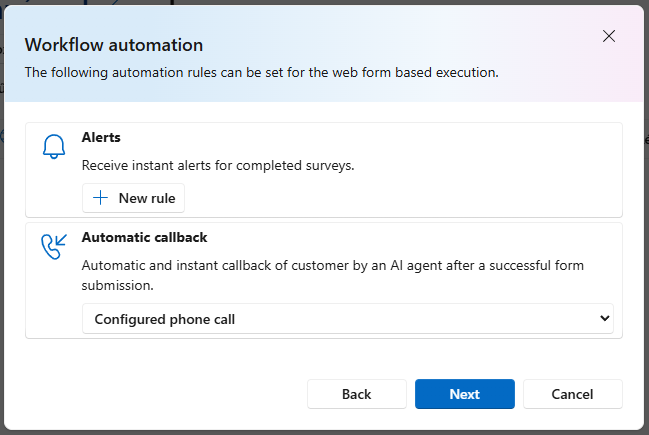
Configure automatic routing from web survey to AI voice callThe timing is intentional. Calling while the respondent is still mentally engaged dramatically improves completion rates. There's no "we'll get back to you later," no scheduling friction, and no context loss. From the user’s perspective, it feels like a natural continuation rather than a handoff.
From a technical standpoint, this required tight orchestration between our survey engine, routing logic, and AI voice infrastructure. The web and phone parts share a single survey definition, a unified response model, and consistent validation rules. Answers collected on the web are available to the AI agent in real time, allowing the call to be personalized, contextual, and efficient. The agent has the whole context, it doesn't repeat questions, doesn't ask what it already knows, and adapts dynamically based on previous responses.
The result is a hybrid survey flow that plays to the strengths of each channel. Web for speed and convenience. Voice for nuance, follow-ups, and higher-effort questions. Fully automated, end to end.
This opens the door to smarter routing, more advanced workflows with higher conversion.